
Rome Points Of Interest
The Vatican
(Linda, the link above goes to a map created on our site)
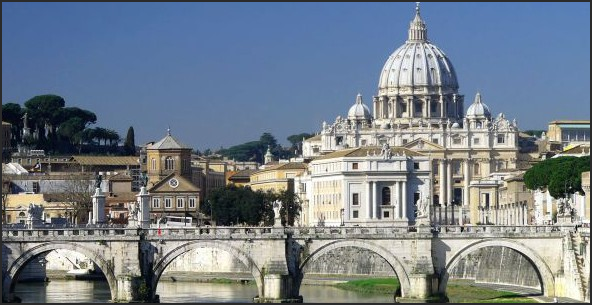
Peter’s Basilica
The beating heart of Catholicism, St. Peter’s draws millions of pilgrims every year; they arrive from every part of the world to unite in prayer and receive the Pope’s blessing.
The construction of the Basilica that now dominates St. Peter’s Square began April 18, 1506, when the Church was headed by Pope Julius II, and was completed in 1626, during the papacy of Pope Urban VII. The Square, rather, was completed in 1667. On the same site – before the present-day Basilica – stood another basilica from the 4th Century; it had been commissioned by Roman Emperor Constantine I.
A string of architects worked on the Basilica: Bramante, whose collaborators included Giuliano da Sangallo; Raphael, who also collaborated with Giuliano da Sangallo, as well as Frà Giocondo; Antonio da Sangallo the Younger, collaborating with Baldassarre Peruzzi; Michelangelo, Pirro Ligorio and Jacopo Barozzi da Vignola; Giacomo Della Porta, with help from Domenico Fontana; Carlo Maderno and, of course, from 1629 forward, Gian Lorenzo Bernini.
Bernini realized the imposing lateral colonnades in the 17th Century. They are composed of 284 columns in the Doric order, surmounted by 140 statues of the saints that rise to a height of 10.2 ft. Six large crests decorate them, representing Pope Alexander VII (a.k.a. Fabio Chigi). Fruit of Bernini’s architectonic genius, the columns are perfectly arrayed one behind the other, positioned atop porphyry disks and, as if by magic, they seem to move. The Square boasts a diameter of 787 feet, and in its center, an 82-ft tall obelisk.
Taking the stairway – restructured by Bernini and comprising three levels – one arrives at the portico, with five gates lining its 233-ft length. Each one corresponds to one of the front portals of the Basilica. Both the portico and facade are the works of Carlo Maderno. Entering in the Basilica, visitors are immediately struck by the artistic profusion of the interiors, in addition to the evocations effused by this sacred place; still, they often do not immediately perceive the real grandeur of the work.
At the end of the central nave is the statue of St. Peter giving his blessing, with his foot worn by the caressing hands of the faithful. In the right nave is Michelangelo’s esteemed Pietà, marble group of sublime expression, unbelievably created by the artist at just 23 years of age. Symbol of the Catholic Church and of the City of Rome is the principal dome, an impressive work also designed by Michelangelo, and completed after his death by Domenico Fontana and Giacomo della Porta. The interior decoration is realized in mosaic technique, depicting scenes of Christ and the Apostles, and is ornamented with busts of the Popes and Saints. The stairway leading to the top of the cupola boasts a particular design in cantilevered planks, using terra-cotta from Ferentino.
The space underlying the cupola is filled by the monumental St. Peter’s Baldachin, also conceived by Bernini and raised between 1624 and 1633. Composed of bronze withdrawn from the Pantheon, it is 98 feet tall, and is supported by four tortile columns.
The Vatican Grottoes, located under the Basilica floor, hold the tomb of Saint Peter and those of other popes, including John Paul II.
(Linda, the link above goes to a map created on our site)
(Linda, we can put a link here, or anywhere else that goes to a page with our video on it)
Vatican Museums
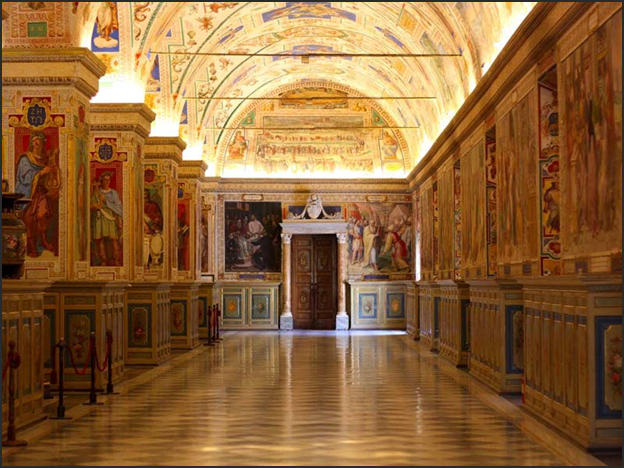
Not very far from the Basilica, tracing the Vatican walls, visitors arrive at the entrance to the Vatican Museums, housing works of art of incomparable value. Among the various exhibition halls, the Museum of Egyptian Art displays numerous examples of sculptures, sarcophaguses and mummies, Mesopotamian cuneiform tablets and seals. The Painting Gallery (Pinacoteca) contains works by Giotto, Caravaggio, Beato Angelico, Perugino, Leonardo, Titian and Raphael.
(Linda, the link above goes to the Google page – not on our site like the links above)
Vatican Palaces
In the Vatican Palaces visitors are allowed to enter Raphael’s Rooms, decorated with beautiful frescoes realized by the artist between 1508 and 1524.
Sistine Chapel
The main attraction is the Sistine Chapel, a wonderful masterpiece achieved with the contribution of many artists, among them Perugino, Botticelli, Rosselli and Ghirlandaio. Although the most famous contribution is undoubtedly Michelangelo’s painting of the ceiling, along with the Last Judgment behind the altar.
The Sistine Chapel is known throughout the world, not only for its magnificent decoration.
(Linda, I laid out the content below a little differently. We can modify this to look like the layout above or we can layout the content above to look like this below.)
Fountains of Rome
For Rome’s tourists, the ancient fountains in front of the Spanish Steps, in Piazza Navona, that called Trevi and many others are the objects of ceaseless wonder and admiration. And Romans’ age-old relationship with their water is unique and eternal, given the majesty of their aqueducts and, above all, their fountains. For the ancient Romans, water was indeed a gift from the gods, and every H2O source had its own tutelary god or nymph. Such supersition can be found as a component in numerous ancient myths, one being that of the nymph Egeria, lover and wife of Numa Pompilius, one of the seven Kings of Rome.
A fundamental of life, health and hygiene, water was the central-most element of that ancient Roman society that socialized at the baths. In later centuries, the abundance of water in the Region of Lazio, channeled through the aqueducts, became a means for the Catholic Church to manifest its power on earth: still today we see the family crests of the most powerful Popes branded onto many a Roman fountain.
One among these is the “Fontana della Barcaccia” in Piazza di Spagna (right in front of the Spanish Steps, otherwise known as the Scalinata di Trinità dei Monti. The Barcaccia (1627-1629) is the work of Gian Lorenzo Bernini’s father, Pietro. The name Barcaccia refers to the legend that a boat (barca in Italian) was found in the Piazza after the River Tiber flooded in 1598. Not far from here lies Piazza Barberini and the Fontana del Tritone, from 1643. Realized by Bernini the younger, it features four dolphins supporting Triton, who is blowing water through a shell.
Of course, Rome’s most spectacular and most famous fountain is the Four Rivers Fountain, also Bernini’s baby. The fountain represents – via four rivers – the four continents known at the time of its construction. We see the Danube, the Ganges, Rio della Plata and the Nile, veiled given the then lack of knowledge regarding its source. The fountain was built by Bernini’s apprentices at the center of the ancient Domitian Stadium, today’s Piazza Navona.
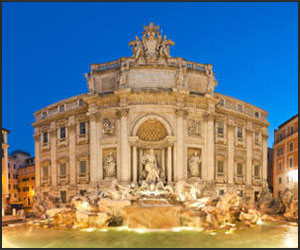
The monumental Trevi Fountain, then, is the fruit of long-running, discontinuous operations by various architectects, including Bernini; yet its actual completion is the merit of Nicola Salvi and Giuseppe Pannini, who put the finishing touches on the fountain sometime between 1732 and 1766. At its center is a very large statue of the god Oceanus atop a shell-shaped chariot pulled by two of Triton’s horses. To each side of the god are the statues of Health and Abundance. While the Fountain of the Naiads in Piazza Repubblica bears Glauco grasping at a dolphin at its focal point, the fountain’s name originates from the nude bronzes – the Naiads – that surround him. The work, signed by Mario Rutelli, was inauagurated in 1914.
Another fountain, less-famous, js tucked-away in Piazza Sant’Eustachio, near the Pantheon. Dating as far back as the Imperial Roman age, the fountain was part of Nero’s Baths complex; sculpted in granite, it was positioned next to the Senate of the Republic in 1987 to commemorate the anniversary of the Italian Constitution.
Finally, the Fontana delle Tartarughe or Fountain of the Turtles, stands in a cosy little square in Rome’s Jewish Ghetto. Designed by Giacomo Della Porta, it is an elegant structure in marble and bronze, with at its centerpiece youths or ephebes that hover over dolphins and conch shells, while at the same time encouraging the turtles into the basin above with.
Piazza Navona
(need text)
(Linda, we may want to consider creating a separate map for each item in this section and we can link to them)
Fontana della Barcaccia
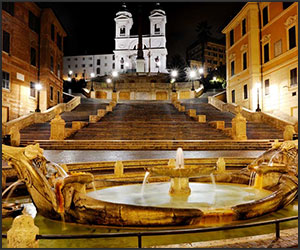
Fontana della Barcaccia at the Spanish Steps or known as the Scalinata di Trinita dei Monit.
The Barcaccia (1627-1629) is the work of Gian Lorenzo Bernini’s father, Pietro. The name Barcaccia refers to the legend that a boat (barca in Italian) was found in the Piazza after the River Tiber flooded in 1598.
Fontana del Tritone
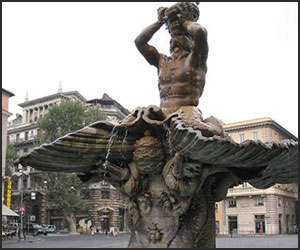
Fontana del Tritone – The four dolphins supports the Triton, who is blowing water through a shell. Located at Piazza Barberini and realized by Bernini the younger in 1643.

Trevi Fountain
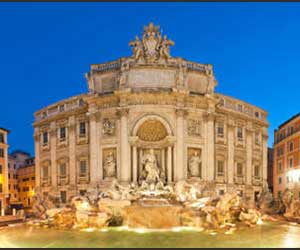
TREVI FOUNTAIN, Fontana di Trevi, located at Piazza di Trevi about 1km from the Spanish Steps.
Nicola Salvi designed the Baroque fountain in a location that was considered the junction of the aqueducts that supplied water to ancient Rome. The fountain “Coin toss” meant that you would return to Rome! Hear Frank Sinatra sing “Three Coins in the Fountain” in the movie by the same name with scenes of the ancient area that we all like to visit.
Fontana delle Tartarughe
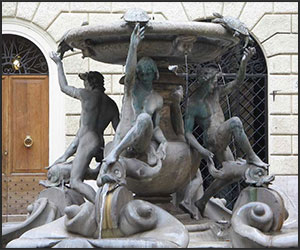
Fontana delle Tartarughe, or Fountain of the Turtles, stands in a cozy little square in Rome’s Jewish Ghetto. Designed by Giacomo Della Porta, it is an elegant structure in marble and bronze, with at its centerpiece youths or ephebes that hover over dolphins and conch shells, while at the same time encouraging the turtles into the basin above with.
Linda, visit this page to get an idea of a different page design. https://mouthflapper.com/map-of-rome/
Linda – Below are three different map sizes we can choose from: